
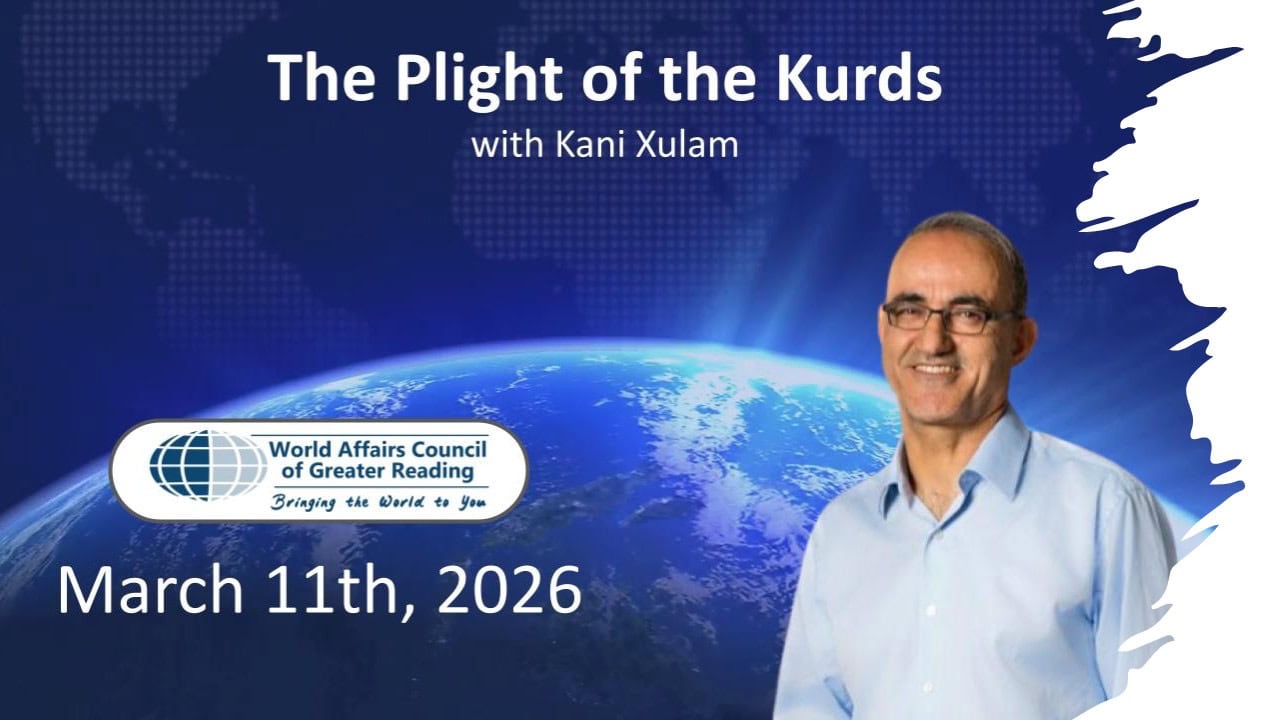

Remarks by Kani Xulam
World Affairs Council of Greater Reading
March 11, 2026
It is customary in settings like these to acknowledge one’s host, so I want to do just that and offer my heartfelt thanks to David Huyett of the World Affairs Council of Greater Reading for inviting me to engage you in a conversation about my people, the Kurds.
When he offered me the choice of coming here or addressing you via Zoom, I told him I prefer being in the same room with my audience, and I accepted his invitation to visit your city in person. I am glad I did. I hope you too will feel the same—after my talk.
First, let me indulge in a bit of humor and tell you an American joke.
A farmer takes his cow to the market to sell. Another farmer comes by and asks, “Does your cow give a lot of milk?” The farmer replies, “I don’t know if my cow gives a lot of milk, but I do know this: my cow will give you everything she has!”
I like the joke and use it often to make a point. Although I am a Kurd, I am not so sure I know a lot of things about the Kurds. But I do know this—and you can be sure of it: like the farmer’s cow, I will give you everything that I have.
Hopefully, it will be as wholesome and nutritious as the cow’s milk. But if it isn’t, please don’t blame my host. Blame me—the wandering Kurd, still trying to make a case for my people, still working to make the world a friendlier place for the Kurds.
Now, my story.
Think of it as a three-step ladder leaning against a wall. I invite you to climb it with me. On the first step, we meet a fire-and-brimstone cleric in Tehran. On the second, a communist-turned-nationalist in Belgrade. On the third, a furious president in Ankara.
When we reach the top, I hope the experience will be something like climbing Mount Nebo in the Old Testament. The Bible tells us that from its peak, Pisgah, Moses looked out and saw the Promised Land. From my imaginary wall, you too will catch a glimpse of my homeland—Kurdistan.
The Old Testament speaks of a Promised Land “flowing with milk and honey.” In the Kurdish homeland, what flows these days is not milk and honey but tears mixed with blood. I will speak about the authors of our miseries—and, if time permits, try to lighten the mood with another joke, this time about a grinning Kurdish cow.
“Public policy is a letter we write to our children about the kind of nation we want to be,” says Senator Raphael Warnock of Georgia. The same, I believe, applies to presidential visits. President Trump, as your last guest pointed out, has visited Saudi Arabia twice. President Carter, when he moved into the White House, visited Iran once.
As 1977 was coming to a close and the new year was about to begin, Carter offered his host a toast: “Iran is an island of stability in one of the more troubled areas of the world.” Ten days later, protests broke out in Tehran. Thirteen months later, the shah abdicated his throne.
As the doctors among us will tell you, the medical profession is strictly regulated to ensure public safety. That is a good thing. Future doctors take an oath to do no harm. And we believe them—we trust them with our lives. They have secure jobs. We live longer than our parents did.
Politicians cannot say the same about their profession. There is no school for presidents or prime ministers, as far as I know. Future presidents take no oath to do no harm. Adolf Hitler professed concern for animals but not for humans, and on his watch sixty-five million of us—mostly civilians—met violent ends.
So when the Shah left Iran for the last time in 1979, the man who replaced him was not his son but Ayatollah Ruhollah Khomeini, a Persian cleric. The judgment of the American Ambassador in Tehran was that the cleric had the potential to become the Persian Mahatma Gandhi.
As the succeeding days, months, and years would show, the judgment reflected a wish rather than reality.
The Kurds—my people—make up at least 15 percent of Iran’s population, not unlike French Canadians in English Canada. They wanted political space: autonomy in Kurdistan and democracy in Iran. They want the same today. But the Persian cleric would hear none of it.
Instead, he sent us his army and a hanging judge. The soldiers stayed; the hanging judge left. In between, thousands of Kurds met untimely brutal ends.
But what distinguishes Ayatollah Khomeini from other rulers in the world, at least for the purposes of this talk, was his reaction to the news of Iraq’s attack on Iran on September 22, 1980. He viewed it as a gift from heaven.
The two countries battled each other for eight long years. Both sides violated international norms. Iran sent indoctrinated teenage volunteers in human-wave assaults. Iraq used banned weapons to compensate for its smaller population.
Close to a million men became food for fish in the Shatt al-Arab—or fertilizer in the killing fields between Iraq and Iran. And in Washington, the cold calculus of geopolitics could be heard: “It’s a pity both sides can’t lose.”
While the war was raging, Iraq found a patron in Washington and used banned chemical weapons with impunity: first against Iranian soldiers, and later against Kurdish civilians.
In one Kurdish city—Halabja—Saddam gassed as many as five thousand Kurds, thirty-eight years ago this month.
Now let us climb the second step of my imaginary ladder.
If the first killing fields lay in Iran and Iraq, the second would lie in the Balkans—Kosovo, Croatia, Bosnia, and Serbia. A different geography, but the same human tragedy. The spark came on September 3, 1987. A mentally disturbed Albanian draftee in the Yugoslav Army killed four Serbian soldiers.
When the news reached Belgrade, the president of the League of Communists of Serbia, Slobodan Milošević, greeted it as “God-sent”—a gift from heaven.
The Berlin Wall was still standing. The Soviet Union was still intact. In the socialist world—and Yugoslavia was still part of it—enmity was not supposed to run between peoples but between classes.
Yet in those fateful years, nationalism was replacing class struggle, and Milošević cast the Serbs as good and the Albanians as bad—to win favor with the former.
I do not know whether Slobodan Milošević had read John Steinbeck’s American classic The Grapes of Wrath. Whether he had or not, he understood the script Steinbeck so painfully described.
First, persuade ordinary people that they are decent and virtuous—and that the neighbors in their midst are dirty, dangerous, and degenerate. Once that idea takes hold, the rest becomes all too easy: good people must defend themselves.
In Steinbeck’s California, the Californians turned against the Okies. In the Balkans, Milošević urged the Serbs to turn against the Kosovars.
Observing Milošević in person was the independent journalist Milo Vasić. Asked about the Serbian leader, he once told the American ambassador, Warren Zimmermann: “You Americans would become nationalists and racists too if your media were entirely in the hands of the Ku Klux Klan.”
But Milošević did not get away with murder. Pushed back into Serbia proper, his regime was brought down by nonviolent, student-led demonstrations, backed by workers and even the police.
He was taken into custody on April 1, 2001, and eighty-eight days later found himself accused of war crimes in The Hague. He died peacefully—though in a prison cell—a fate he denied to thousands of his victims—Bosnians, Croats, and Kosovars.
I have now come to the third step of my ladder.
The furious president I want you to meet is Recep Tayyip Erdoğan—the leader of Turkey for the last twenty-four years. He was supposed to be a preacher in a mosque rather than the mayor of Istanbul, the prime minister of Turkey, and now its president—some already whisper, perhaps for life.
Presidents for life are, alas, common—especially in the Middle East. Saddam Hussein thought of himself as one. Even Secretary of State Madeleine Albright—who sought to sanction and contain him—once said that “biology would take care of him.”
But then there is the Yiddish saying: “Man makes plans, and God laughs.” …
We all know where we were on the morning of September 11, 2001. I was sitting in a replica prison cell we had built at Sheridan Circle—across from the Turkish ambassador’s home—calling it the Cell of Atonement for Turkey’s Political Crimes Against the Kurds.
My phone rang. A friend from New York said the Twin Towers had been struck. On that day biology moved into overdrive—and the clock began ticking for the butcher of Baghdad.
If that ruptured moment in America’s history took Saddam Hussein to the gallows, it also helped propel Mr. Erdoğan’s rise to power in Turkey. At the time, he was on probation for inciting religious enmity by reciting a poem—“The Soldier’s Prayer”—in a mosque, a call to arms in a country already reeling from political instability.
Unable to run for public office, his party won one third of the vote in the elections of 2002, but two thirds of the seats in parliament. In Turkey at the time, political parties had to clear a 10-percent threshold for their votes to count. In 2002 many did not. Their failure doubled the parliamentary representation of Erdoğan’s party.
But Erdoğan himself could only watch from outside—as a citizen.
Then citizen Erdoğan met President Bush. Ankara mattered to the first; Baghdad was on the mind of the second. For Bush, Osama bin Laden fit the bill as a bad Muslim. Recep Tayyip Erdoğan, his aides suggested, could pass as a good one.
When they met, Bush told him,
“You believe in the Almighty, and I believe in the Almighty. That’s why we’ll be great partners.”
To the Kurds of the Middle East, it must have looked like a grim round of musical chairs. On March 14, 2003, Washington welcomed Mr. Erdoğan—a prime minister whose view of the Kurds left little room for their agency—in Ankara. Weeks later, on April 9, Saddam Hussein—the Kurds’ longtime tormentor—was toppled in Baghdad.
The Iraqi Kurds celebrated the fall of their tyrant.
No such luck has greeted the Kurds of Turkey.
As mayor of Istanbul, Erdoğan earned a reputation for keeping Istanbul clean. As a national leader, however, he soon took on the airs of a dictator—and kept Turkish politics clean of Kurds asking for a seat at the table.
Good doctors make a point of learning from other good doctors. The same goes for dictators. In the West, popular culture has familiarized us with the slogans of strongmen.
Mussolini proclaimed: “Un popolo, uno Stato, un Duce.” Franco echoed him: “Un Estado, un País, un Jefe.” Hitler followed with: “Ein Volk, ein Reich, ein Führer.” Each preached the same creed: one people, one state, one leader.
Less often noted is that a Turkish version came earlier—born of Young Turk ideology and tested with deadly consequences on the Armenians: “Tek millet, tek vatan, tek devlet.” One nation, one homeland, one state.
Erdoğan has since expanded the formula. Across Turkey—and sometimes in the Kurdish east—he shouts: “One nation, one flag, one homeland, one state, one leader.”—a warning the Kurds cannot fail to hear.
If we stopped people on the streets of Reading and asked them about Mussolini, Franco, or Hitler, many would know what they did in Europe and some even in Ethiopia. Very few would know what Erdoğan is doing to the Kurds.
In December 2002, when Erdoğan visited the White House as a private citizen, he also traveled to the Kremlin as the guest of President Putin. In Washington, citizen Erdoğan held no press conference after meeting with President Bush. In Moscow, he did.
A Kurdish resident of Moscow was in the audience. Instead of asking a question, he appealed to Erdoğan to address Kurdish concerns and expressed the hope that he might bring an end to their long suffering.
It was a bit like Benjamin Franklin asking King George III to show a decent respect for the opinions of mankind. Erdoğan responded accordingly.
“There is no Kurdish question in Turkey. If you believe there is a question, only then is there a question. If you believe there isn’t a question, then there is no question. If we say there is a Kurdish question, we become part of the problem. For us, no such problem exists.”
By then the Kurdish rebellion against the Turkish state was eighteen years old. Some thirty-five thousand Kurds were dead; Turkish casualties stood at roughly six thousand.
Turkish officials rarely count Kurdish dead. Instead, they speak of “forty thousand victims,” a number in which Kurdish corpses quietly swell the tally of the Turkish dead. All the more striking, then, that Erdoğan showed little respect even for the Turkish dead.
That he said this in Russia—the country that produced one of the greatest readers of human character, Fyodor Dostoevsky—was telling… The Russian novelist knew a thing or two about lying and its corrosive effects on human life.
What the monastery’s elder tells the philandering Fyodor Pavlovich Karamazov could, with equal candor, be said of Recep Tayyip Erdoğan.
Tayyip, incidentally, means pure and virtuous in Turkish.
Here is what Elder Zosima tells Fyodor Karamazov:
“Above all, do not lie to yourself. A man who lies to himself and listens to his own lie comes to a point where he no longer discerns any truth either in himself or anywhere around him, and thus falls into disrespect toward himself and others.
“Not respecting anyone, he ceases to love, and having no love, he gives himself up to the passions and coarse pleasures in order to occupy and amuse himself, and in his vices reaches complete bestiality—and it all comes from lying continually to others and to himself.”
On July 15, 2016, I was driving with a friend to Cleveland, Ohio, to attend the Republican National Convention. As we made our way along the highway, my Twitter feed suddenly came alive. Turkish army officers were attempting to assassinate the president and install a military dictatorship.
By midnight in Turkey, the coup had fizzled out. A triumphant Erdoğan took to the airwaves. Instead of promising to prosecute the would-be dictators with the full force of the law, he declared, “This is a blessing from God.”
More than a few have since suggested that he knew of the plot all along.
What those officers failed to do—establish a dictatorship—he did himself. He suspended the constitution and ruled by decree for the next two years. During that time, torture—after a brief holiday—returned to Turkey in full force.
Here is how Madeleine Albright, in her book Fascism: A Warning, summarized the purge that followed:
“140,000 government employees were suspended or fired, 16,000 military and police officers cashiered, 6,300 teachers purged, 2,500 journalists sacked, 1,000 businesses seized, 180 media outlets shut down, fifteen universities closed, and one out of every five judges forced to resign.”
Nations are the building blocks of the United Nations, and national politics is supposed to remain within the borders of nation-states. Yet Erdoğan’s ambitions, like his border-crossing soldiers, drones, and fighter planes, ignore those borders.
Integrity, I am happy to note, has begun to cross them as well.
If the history of the American Revolutionary era interests you, you will probably agree that its great chronicler, Gordon S. Wood, is second to none. If Turkey and its turbulent history interest you, the Dutch historian Erik-Jan Zürcher enjoys a similar distinction.
The Turkish government knew this and awarded him its Distinguished Service Award in 2005.
But in 2017, Mr. Zürcher made a remarkable gesture—he returned the award to the Turkish government. Having once supported Prime Minister Erdoğan’s bid for Turkey to join the European Union, he now urged Europe to keep both him and the Turkey he had helped reshape at arm’s length.
True friends of Turks and Kurds welcomed the gesture.
So what should someone like me do—blessed with the liberal education of your schools, endowed with a healthy body, and protected, as you are, in these United States?
What would you do if you were me? …
The easy course would be not to read the news, not to watch Erdoğan’s handiwork, not to care—and to hope that the dark clouds gathering over Kurdistan will one day pass, as they passed over the Soviet Union in 1991.
When the Soviet Union ran its course, fifteen republics declared their independence. Russia, unlike Serbia in Yugoslavia, largely allowed that separation—except in Chechnya, where the demand for independence was met with war.
The principle is simple: every people has the right to decide its own political destiny. The Chechens sought that right and paid dearly for it. The Kurds seek it still. Ukraine is fighting for it today.
For my part, to help bring about the dawn of freedom in Kurdistan—hopeless as it may sometimes seem—I feel compelled to do my part to leave behind a better world. And so I have resolved on a journey—an experiment.
A pilgrimage of love.
A quiet act of faith.
A journey inspired by the belief that love is stronger than hate—and that nonviolent resistance can bring about social change.
Dr. King lived by that faith. In his impromptu speech on the first day of the Montgomery Bus Boycott on December 5, 1955, the young pastor laid out a course for his people—and perhaps for us as well:
“When the history books are written in the future, somebody will have to say, ‘There lived a race of people, a Black people, a people who had the moral courage to stand up for their rights. And thereby they injected a new meaning into the veins of history and civilization.’”
They did.
One day, I hope, the history books will say the same of the Kurdish people: that they learned from the right teachers, that they never rejoiced in the death of their enemies, that they learned to hate the sin but not the sinner—and that by transforming themselves first, they helped transform the Middle East for the better.
They will.
So I invite you to join me on this long walk. The journey will begin at the Martin Luther King Jr. Memorial in Washington, DC, on March 21, 2026—a day that marks not only the Kurdish New Year but also the sixty-first anniversary of the Selma to Montgomery March.
I will be on the road for fifty-five days, walking 746 miles. With luck—and with your prayers—I will have a companion for every mile: 746 Americans, and fifty-five hosts along the way across four states. If all goes well, I will arrive on May 14, 2026, at the birthplace of Dr. Martin Luther King Jr. in Atlanta.
Again, I want to thank you for making room for my musings this afternoon. But before I sit down, I must keep a promise. I owe you the story of a grinning Kurdish cow.
First, a bit of context.
You live in Jefferson’s America, protected by Madison’s Bill of Rights. You do not face checkpoints on your public highways the way we do when we travel from one city to the next.
Now imagine this: a bus ride in Kurdistan.
A Kurd who has been living in the West returns home to visit family in his town. He boards a public bus. Every ten miles or so, the bus is stopped. Soldiers climb aboard and begin checking identity cards.
The bus falls silent. Passengers reach for their identity cards.
The Kurd is sitting next to a Kurdish farmer. After a few checkpoints, he notices something curious: the farmer flashes his identity card the moment a soldier appears.
After a few more checkpoints, the Kurd turns to the farmer and says,
“Don’t let him think you accept this… Tire him out… Let him see that he is wrong…”
The farmer smiles and replies, “Do you know the story of the grinning cow?”
“A farmer takes his cow to the market to sell. Buyers come by and check the cow’s teeth to judge her age. Before long, the cow begins to grin whenever someone comes to check her teeth.”
The farmer pauses… …
“You see… this republic has made cows… …of us all.”
0 Comments